
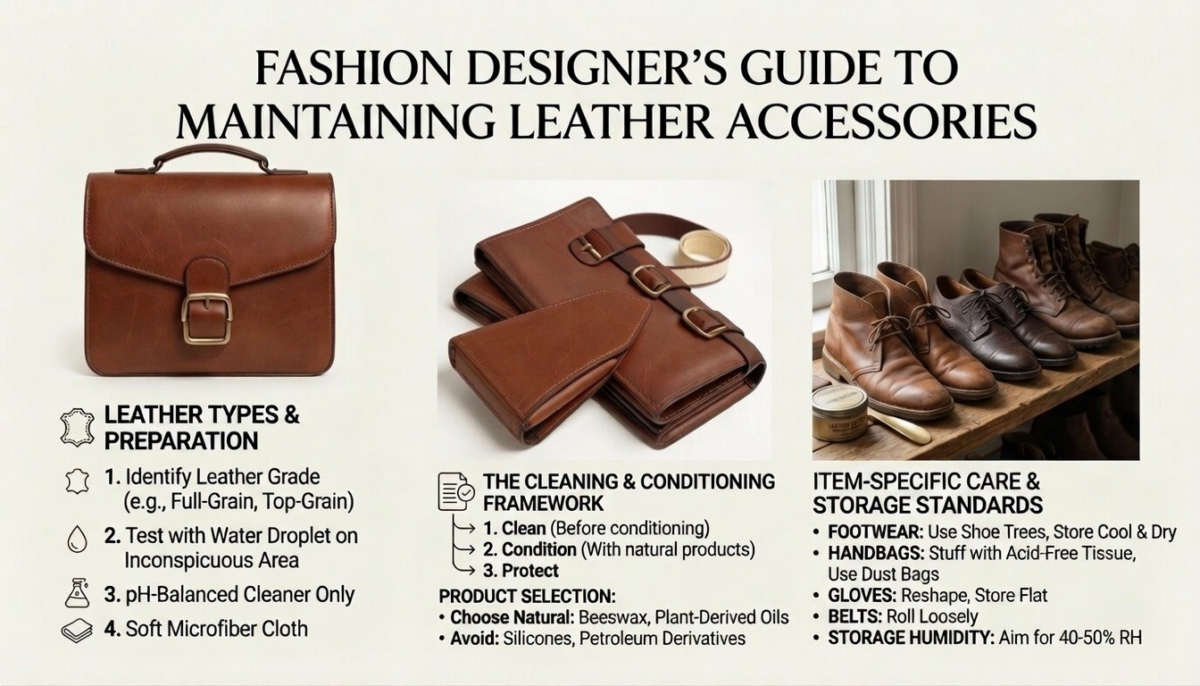
Leather has occupied a central position in fashion for centuries — not as a passing trend, but as a material that carries weight, history, and craft. From structured handbags and tailored jackets to belts, gloves, and footwear, leather accessories represent some of the most technically demanding and financially significant pieces in any collection or personal wardrobe.
Designers who work with leather understand something that many consumers do not: the quality of a leather piece at the point of sale is only the beginning of its story. What happens in the months and years following purchase — how the leather is cleaned, conditioned, stored, and protected — determines whether the piece reaches its potential or deteriorates long before its time.
In fashion industry circles, leather care is not a peripheral concern. It is part of the material literacy that separates designers and stylists who work with leather seriously from those who treat it as any other fabric. This guide outlines the principles and practices that inform professional leather accessory maintenance, presented in terms that apply equally to fashion studios, retail environments, and private wardrobes.
1. Understanding Leather Grades and Why It Changes Everything
Before any maintenance decision can be made intelligently, the leather grade must be identified. The fashion industry uses leather across a spectrum of grades and finishes, each with distinct care requirements. Applying the wrong product to the wrong leather type is among the most common — and most costly — mistakes in accessory maintenance.
The primary leather grades used in fashion accessories:
- Full-grain leather — The highest quality grade, retaining the complete outer surface of the hide with all natural grain intact. Used in premium handbags, high-end footwear, and bespoke belts. Develops a rich patina over time but requires careful conditioning to prevent drying.
- Top-grain leather — The most common grade in luxury fashion. The surface has been lightly sanded to remove imperfections, with a finish coat applied. More uniform in appearance than full-grain but slightly less breathable.
- Aniline leather — Dyed with soluble dyes that penetrate the leather without applying a surface coating. The most natural-feeling and visually transparent grade — the grain shows fully. Highly sensitive to moisture, oils, and UV. Common in premium gloves and select handbag interiors.
- Nubuck — Full-grain leather that has been buffed on the grain side to create a soft, velvety surface. Requires specialist nubuck-specific care products; standard conditioners can permanently alter the surface texture.
- Suede — Split leather with a napped finish. The most delicate grade for maintenance purposes — water-sensitive and easily marked. Requires dedicated suede brushes and protective sprays rather than liquid conditioners.
The leather accessories care guide principle is foundational: identify the grade before selecting any product. Most designer brands include leather type information in the product documentation or on the care label. For vintage or unlabeled pieces, a simple water droplet test on an inconspicuous area reveals whether the leather is treated (droplet beads) or untreated aniline (droplet absorbs).
Misidentifying leather grade and applying an incompatible product — particularly a heavy wax conditioner on suede or nubuck — produces damage that cannot be reversed without professional intervention.
2. The Cleaning Framework: Precision Before Product
In fashion industry leather care, cleaning is the step that separates professional outcomes from amateur ones. The sequence is non-negotiable: clean first, then condition, then protect. Conditioning uncleaned leather traps surface contamination within the grain and accelerates the degradation that conditioning is intended to prevent.
Cleaning protocol for smooth leather accessories:
- Remove surface dust and loose debris with a soft, dry brush or lint-free cloth
- Apply a pH-balanced leather cleaner to a microfiber cloth — never directly to the leather
- Work across the surface in small sections using light circular motions
- Pay particular attention to high-contact zones: bag handles, jacket collar and cuffs, belt holes and buckle areas
- Remove all cleaning residue immediately with a separate dry cloth
- Allow the leather to dry fully at ambient room temperature before conditioning
For nubuck and suede:
- Use a dedicated nubuck or suede brush to lift surface debris with short, directional strokes
- Apply specialist foam or dry cleaning products formulated for napped leathers
- Never apply water or liquid cleaner directly to suede — moisture causes permanent tide marks
- Restore the nap direction with a clean suede brush after drying
For leather jacket maintenance in a fashion context, the collar and cuff zones deserve particular attention. These areas accumulate body oils, perspiration residue, and cosmetics that penetrate the leather’s surface with repeated contact. Left uncleaned, these deposits discolor the leather and create accelerated wear patterns that are visible from across the room on a well-lit runway or showroom floor.
The leather care for fashion industry standard is that cleaning should precede every conditioning treatment, not just the first one. A light clean before each quarterly conditioning session is the professional baseline for smooth leather accessories in regular use or display rotation.
3. Piece-by-Piece Maintenance: Accessories Are Not All the Same
A leather handbag, a leather jacket, a leather belt, and a pair of leather gloves face entirely different use conditions, stress patterns, and environmental exposures. Treating them identically produces inconsistent results. Professional leather care calibrates the routine to the specific demands of each accessory category.
Leather Handbags
Handbags are among the most structurally complex leather accessories. They face external surface exposure, internal lining contact with contents, handle stress at the attachment points, and hardware contact along zips, clasps, and feet. How to maintain leather handbags at a professional standard requires attention to each of these zones independently.
Handle attachment areas are the most frequent failure point. The leather around rivets, stitching, and D-rings flexes continuously during use and is the first zone to show cracking. A conditioning treatment applied with particular focus to these areas — working the product into the seam lines — significantly extends the structural integrity of the handle assembly. Metal hardware should be covered with a dry cloth during conditioning to prevent product staining on polished fittings.
Bag interiors are commonly overlooked. The lining transfers oils and dye from the leather to contents and vice versa. Wiping the interior periodically with a clean, dry cloth and allowing it to air between uses prevents odor development and lining deterioration.
Leather Belts
Leather belt care tips consistently identify the same two failure zones: the hole section, which receives repeated stress from the belt prong, and the buckle interface, where the leather folds back on itself continuously. Conditioning these zones every six to eight weeks during regular use prevents the cracking that makes a quality belt unwearable long before the body of the belt shows any visible wear.
Leather Gloves
Gloves present a unique challenge because they are worn against bare skin and flex at every finger joint simultaneously. Conditioning gloves requires working the product into the leather while wearing them — allowing the body heat and movement to assist absorption. After removal, gloves should be reshaped by hand and stored flat or on glove formers rather than folded.
4. Conditioning: Selecting the Right Product for Fashion Leather
The conditioning product selection is where many leather care routines succeed or fail. The fashion industry has specific requirements that differ from general leather care: products applied to wearable accessories must condition without leaving tackiness or residue that transfers to clothing, must not alter the surface finish or color, and must be safe for skin contact during wear.
Silicone-based conditioners — common in general-purpose leather care — present a problem for fashion leather. While they deliver an immediate softening effect and surface sheen, silicone accumulates within the leather’s pores over time, reducing breathability and creating a surface that is difficult to re-treat with other products. They can also accelerate the breakdown of certain finish coats used on top-grain fashion leather.
Petroleum-based products carry similar concerns. They soften leather effectively but can darken light-colored pieces permanently, degrade stitching thread over time, and leave an oily residue that compromises the tactile quality of a piece designed to be handled.
For fashion accessories — particularly those in lighter colors, fine grain, or high-contact applications — natural formulations based on beeswax or plant-derived oils offer a more compatible alternative. These products condition the leather’s fiber structure without synthetic accumulation, provide a degree of water repellency, and do not alter color in the way that heavier petroleum products can. For designers and stylists sourcing a conditioning product that performs across multiple leather accessory types, a natural leather conditioner formulated without silicones or synthetic additives provides the consistency and material compatibility that fashion-grade leather requires. Applied to jackets, bags, belts, and footwear with a single product, it simplifies the care routine without compromising the standard of care each piece deserves.
Application technique matters as much as product selection. A small amount of conditioner — less than most people instinctively apply — worked into the leather with a clean microfiber cloth in circular motions, followed by a ten-minute absorption period and a light buff, delivers better results than a heavy application that sits on the surface and is wiped off before it penetrates.
5. Sustainable Leather Care: The Direction Fashion Is Moving
Sustainability has become a central concern in fashion at every level — from material sourcing and production to the end-of-life management of garments and accessories. Within this broader conversation, leather care plays a meaningful but often overlooked role.
Extending the life of a leather accessory through consistent maintenance is one of the most direct sustainability actions available to both designers and consumers. A leather jacket maintained correctly for twenty years represents a significantly lower environmental footprint than the same jacket replaced four times over the same period. The same calculation applies to handbags, footwear, and belts.
The product choices made within a leather care routine also carry sustainability implications. Conditioners formulated with synthetic chemicals, petroleum derivatives, or non-biodegradable compounds introduce these substances into the home and studio environment repeatedly. Natural formulations — beeswax-based, plant-oil-derived, free from volatile organic compounds — align more closely with the sustainability standards that forward-thinking fashion brands and designers are applying to other areas of their practice.
This shift toward non-toxic, natural care products is not confined to fashion. Interior designers and homeowners are making the same transition for leather furniture and wood surfaces in residential settings. For those interested in how this principle extends to the home environment, a resource on non-toxic care products for modern interiors examines how natural product choices apply across leather upholstery, wood surfaces, and other interior materials — a useful reference point for designers whose practice spans both fashion and interior contexts.
The sustainable leather care position in fashion is straightforward: buy quality, maintain consistently, use natural products, and replace less. It is both the environmentally responsible approach and the economically rational one.
6. Storage Standards That Preserve the Investment
In fashion studios, showrooms, and professional wardrobes, storage is recognized as an active component of leather maintenance rather than a passive one. The conditions in which leather accessories are stored between uses determine how much of the conditioning work is retained and how quickly degradation progresses in unworn periods.
Professional storage standards for leather accessories:
- Handbags: Store stuffed with acid-free tissue paper to maintain shape; on open shelves or in breathable dust bags — never in plastic; avoid stacking under other items
- Jackets: Hang on wide, padded hangers with sufficient space to avoid shoulder compression; breathable garment covers rather than dry-cleaning plastic; away from direct light
- Belts: Roll loosely or hang from a belt rack; avoid tight coiling that stresses the leather at the curve; store separately from metal buckles that can press marks into the surface
- Gloves: Store flat on glove formers or wrapped in acid-free tissue; never folded at the fingers; in a cool, dry environment with stable humidity
- Footwear: Shoe trees in natural cedar to maintain shape and absorb residual moisture; stored in breathable boxes or on open racks; never sealed in airtight containers
The environmental conditions of the storage space matter as much as the physical arrangement. Leather stored in areas with humidity above 65% is at risk of mold development. Humidity below 30% accelerates oil evaporation and stiffening. The ideal storage environment sits between 40–55% relative humidity at a consistent temperature — conditions that align with standard interior comfort levels in climate-controlled spaces.
For designers managing a significant inventory of leather samples, archive pieces, or client wardrobes, a periodic inspection schedule is as important as the storage setup. Checking stored leather every six to eight weeks allows early identification of mold, color transfer, or dryness before these issues require professional intervention. Sourcing leather care products from a specialist with a complete natural range means that any treatment identified during inspection — conditioning, cleaning, or waterproofing — can be addressed immediately with a compatible product already in the studio.
Conclusion
Leather accessories occupy a unique position in fashion — they are simultaneously the most durable and the most demanding category of materials that designers and stylists work with. Their longevity is not guaranteed by the quality of the original manufacture. It is earned through the consistency of the care applied after the piece leaves the atelier or the retail floor.
The practices outlined in this guide — precise leather grade identification, disciplined cleaning before conditioning, piece-specific maintenance routines, natural product selection, sustainable care principles, and professional storage standards — represent the approach that fashion professionals apply to leather when they intend to preserve it at the level its craftsmanship deserves.
For designers, the material literacy that drives these decisions is part of the professional standard. For consumers who invest in quality leather accessories, it is the most direct way to protect that investment and extend the life of pieces that, maintained correctly, genuinely improve with the passage of time.