
There’s a moment before every entrance that no one talks about.
You’re still in the car. Engine idling. One last glance in the mirror. You check the drape of the fabric, the line of the shoulder, the fall of the shoe. Then the door opens—and the world sees you.
But here’s the truth most people ignore.
They see the car first.
The Grand Arrival
At DC Fashion Week, arrival is choreography.
Not accidental. Not casual. Every detail is considered.
A sharply tailored suit steps out of a vehicle with clean, uninterrupted lines. A model exits a car that mirrors the precision of her posture. A designer arrives in something that feels aligned with their aesthetic language—structured, intentional, composed.
It’s all part of the silhouette.
And yes, the vehicle is part of that silhouette.
Think of it as the ultimate accessory. Not worn—but carried. Not stitched—but engineered.
A polished exterior signals control. Discipline. Awareness of detail.
A damaged one? It fractures the narrative.
A dent along the door. A mismatched panel. Paint that catches light differently on one side.
Subtle? Maybe.
But in this industry, subtle reads as loud.
You wouldn’t step onto a runway in a torn suit. So why arrive in something that suggests the same lack of finish?
When the Image Breaks
Accidents don’t wait for your schedule.
They happen between fittings. On the way to a casting. Somewhere along a route you’ve driven a hundred times without thinking.
And suddenly, everything shifts.
Not just the car.
Your timing. Your focus. Your physical rhythm.
A collision isn’t just impact—it’s interruption.
You’re dealing with calls. Delays. Adjustments. Your calendar—once tight and precise—starts to loosen in all the wrong ways.
And then there’s the personal side.
Even a minor incident can leave you off balance. Not necessarily in a visible way—but internally. Mentally. Physically. Enough to affect how you move, how you present, how you perform.
In an industry where your presence is your currency, that matters.
Because you’re not just showing up.
You’re delivering consistency.
Couture for the Road
Here’s where the conversation shifts.
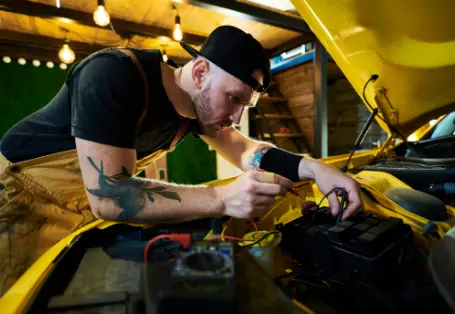
Because restoring a vehicle—properly—isn’t mechanical.
It’s technical artistry.
A master tailor doesn’t simply fix a torn garment. They study the fabric. Match the thread. Reinforce structure without disturbing the silhouette. The repair disappears into the original design.
That same level of precision exists—at its highest level—in automotive restoration.
The lines of a vehicle must return to factory-spec alignment. Not “close.” Exact.
Paint must be matched like a couture dye house would approach color. Not just hue, but tone under light, depth, finish. Metallics must reflect uniformly. Pearlescents must layer seamlessly.
Anything less? It shows.
Choosing the right auto body repair shop is no different than selecting a master atelier for a bespoke piece. You’re trusting someone to restore form, integrity, and visual continuity.
And in both cases, shortcuts are obvious.
A rushed repair is like a poorly altered garment.
It fits—but it doesn’t belong.
The Danger of “Good Enough”
Insurance companies often push for speed.
Quick estimates. Fast approvals. Immediate repairs.
On paper, it sounds efficient.
In reality, it’s a compromise.
Because speed rarely allows for:
- Full structural evaluation
- Precision alignment
- Flawless paint integration
You end up with something functional.
But not refined.
And in your world, refinement is everything.
The difference between good and exceptional lives in millimeters. In light reflection. In how a surface reads from ten feet away—or from across a room.
“Good enough” doesn’t hold up under scrutiny.
And fashion is built on scrutiny.
Restoring the Individual
Let’s not pretend the car is the only thing affected.
You are too.
After a collision, there’s a dual recovery happening.
The machine needs repair. The individual needs recalibration.
You’re managing logistics. Dealing with claims. Trying to stay present in an industry that doesn’t pause.
That’s a lot.
Which is why handling the legal side—property damage, liability, personal injury—isn’t just administrative.
It’s strategic.
Because the more time you spend navigating that process alone, the less time you have to focus on your work. Your clients. Your creative output.
Restoring your professional rhythm requires delegation.
Let the mechanics be handled by experts.
Let the law be handled by experts.
So you can return to what you do best—creating, presenting, performing.
The Psychology of Presentation
There’s a psychological layer to all of this.
When you arrive in something that feels complete—polished, aligned, intentional—you carry yourself differently.
You don’t hesitate.
You don’t second-guess.
You move with confidence.
Now imagine the opposite.
You step out, aware of the imperfection behind you. A visible flaw. A disruption in the image you’ve worked to build.
It lingers.
Even if no one says anything, you feel it.
And in an industry where perception shapes opportunity, that internal shift matters.
Confidence isn’t just internal.
It’s reinforced by your environment.
The Standard You Set
Fashion professionals don’t operate at an average level.
They set standards.
For design. For presentation. For execution.
Your vehicle should meet that same standard.
Because it’s part of your ecosystem.
Part of your visual language.
Part of the story you tell before you even speak.
The Art of the Rebound
Setbacks happen.
Collisions. Delays. Disruptions.
They’re part of life—no matter how carefully curated your schedule is.
What defines you isn’t the interruption.
It’s the recovery.
The ability to return not just to where you were—but to a level that feels even more refined. More controlled. More intentional.
That’s the art of the rebound.
Restoring the machine. Restoring the individual. Realigning the entire composition.
Because in this industry, perfection isn’t static.
It’s maintained.
And every detail—every surface, every line, every arrival—either supports that standard or undermines it.
Choose accordingly.