
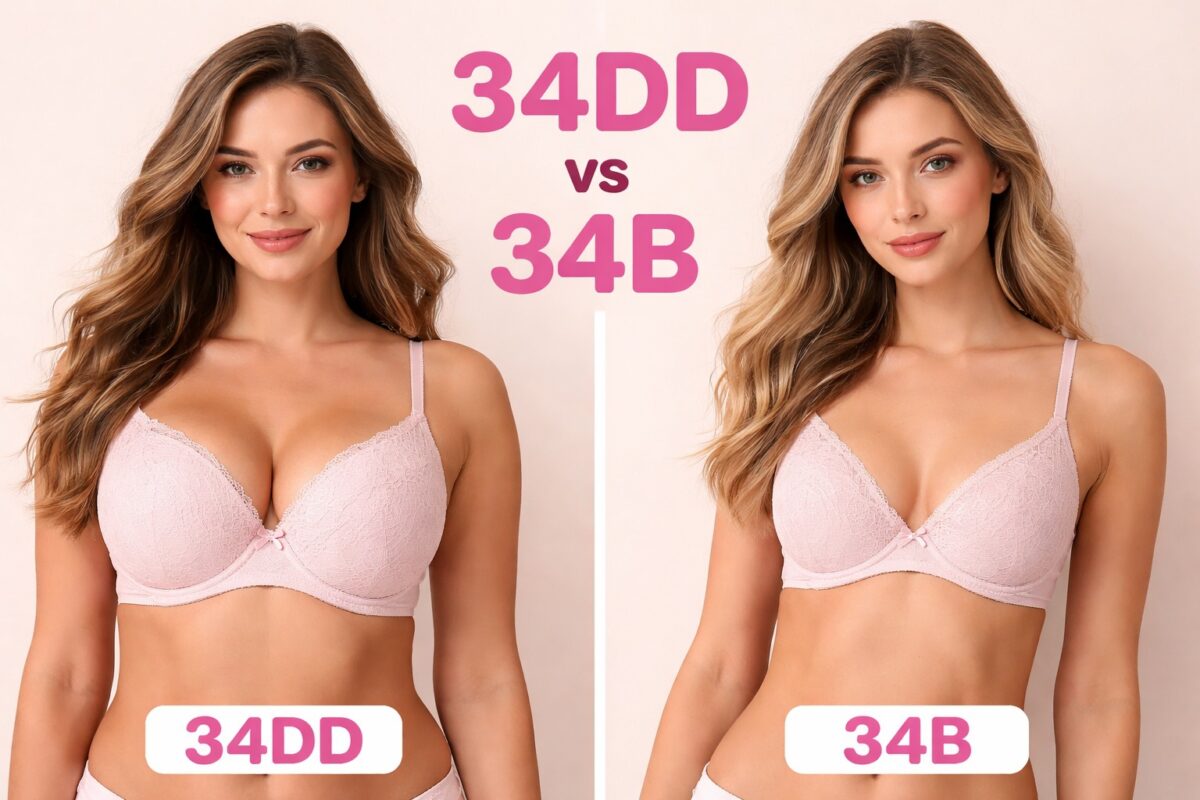
If you’ve ever stood in the bra aisle staring at tags and wondering what all those numbers and letters actually mean, you’re not alone. Bra sizing confuses a lot of people — and questions like “is a 34DD bigger than a 34B?” come up more often than you’d think. The short answer is yes, a 34DD is bigger than a 34B. But let’s break down exactly what that means, because there’s more to it than just one letter being further along in the alphabet.
What Do the Numbers and Letters Mean?
Every bra size has two parts: a number and a letter (or two). The number — in this case, 34 — is the band size. It refers to the measurement around your ribcage, just below your chest. A 34 band means your underbust measures roughly 34 inches.
The letter part — B, DD, etc. — is the cup size. This tells you about the volume of the breast tissue relative to the band. The cup size is actually figured out by comparing two measurements: your bust (around the fullest part of your chest) and your band size. The difference between those two numbers determines your cup letter.
Here’s a simple breakdown of how the difference translates to cup size:
- 1 inch difference = A cup
- 2 inch difference = B cup
- 3 inch difference = C cup
- 4 inch difference = D cup
- 5 inch difference = DD cup
So a 34B means the bust measurement is about 2 inches larger than the band. A 34DD means the bust is about 5 inches larger than the band. That’s a notable difference in volume — the 34DD cup holds significantly more than the 34B cup.
So How Much Bigger Is a 34DD Compared to a 34B?
In straightforward terms, there are three full cup sizes between a B and a DD (B → C → D → DD). Each cup size going up represents roughly an additional inch of difference between the bust and band. So a 34DD has approximately 3 more inches of bust projection compared to a 34B, despite having the exact same band size.
Think of it this way: if you lined up two women both wearing a 34 band, the one in a 34DD would have noticeably fuller, rounder, and more projected breasts than the one in a 34B. The width around their torsos would be the same — it’s purely the breast volume that differs.
The Band Size Is Just as Important
Here’s something a lot of people overlook: the number matters just as much as the letter. You can’t just look at the cup letter in isolation. A 34DD and a 36DD, for example, are actually different sizes — the 36DD has a bigger band AND more cup volume overall.
This is why two people wearing the same cup letter can look very different. A 32DD and a 38DD are both “DD cups” technically, but the actual volume of breast tissue in each is quite different because the band sizes are so different.
For sizing tools and guides that walk you through all of this step by step, resources like BraSizeX can be really helpful for figuring out your correct fit without the guesswork.
Why Does Getting the Right Size Matter?
Wearing the wrong bra size — which studies suggest a large portion of people do — can cause real discomfort. A band that’s too loose won’t give proper support. A cup that’s too small can cause spillage and digging. A cup that’s too big leaves gaps and makes everything feel loose and unsupported.
The right bra should feel snug around the band (you should only be able to slip two fingers underneath), the straps shouldn’t be doing all the heavy lifting, and your breast tissue should sit fully inside the cup without any overflow or empty space.
Real-World Context: How These Sizes Look
A 34B is considered close to what’s often described as an “average” or “medium” bust size. It’s proportional and tends to look balanced on a 34-inch frame. The bust projection is relatively modest.
A 34DD, by contrast, is a fuller bust on the same frame. It’s a size that’s considered well above average in volume and is often associated with a more prominent chest shape. Many people assume DD automatically means “large” in an absolute sense, but remember — it’s still relative to that 34-inch band. On a larger frame, like a 40DD, the overall appearance would be quite different.
Many well-known figures are reported to wear or be estimated at sizes across this range. Looking into celebrity body size comparisons can give you a more visual sense of how different sizes actually look on real bodies, which is often more useful than just staring at measurements on paper.
A Quick Note on Sister Sizes
One more thing worth knowing: bra sizing has what’s called “sister sizes.” These are sizes that have the same cup volume but different band sizes. For example, a 34DD holds the same amount of cup volume as a 36D or a 32E. The cup volume stays constant even though the letter and number change.
This is useful if you’re between sizes or if a particular style doesn’t come in your exact size — you can often try a sister size and get a very similar fit.
The Bottom Line
To put it simply: yes, a 34DD is bigger than a 34B. They share the same band size, but the DD cup is three sizes larger in terms of breast volume. The difference is about 3 inches of extra bust projection, which translates to a noticeably fuller shape.
Understanding how bra sizing works makes it so much easier to shop, find a comfortable fit, and stop second-guessing yourself in the fitting room. Once you know what those numbers and letters actually mean, the whole system starts to make a lot more sense.