
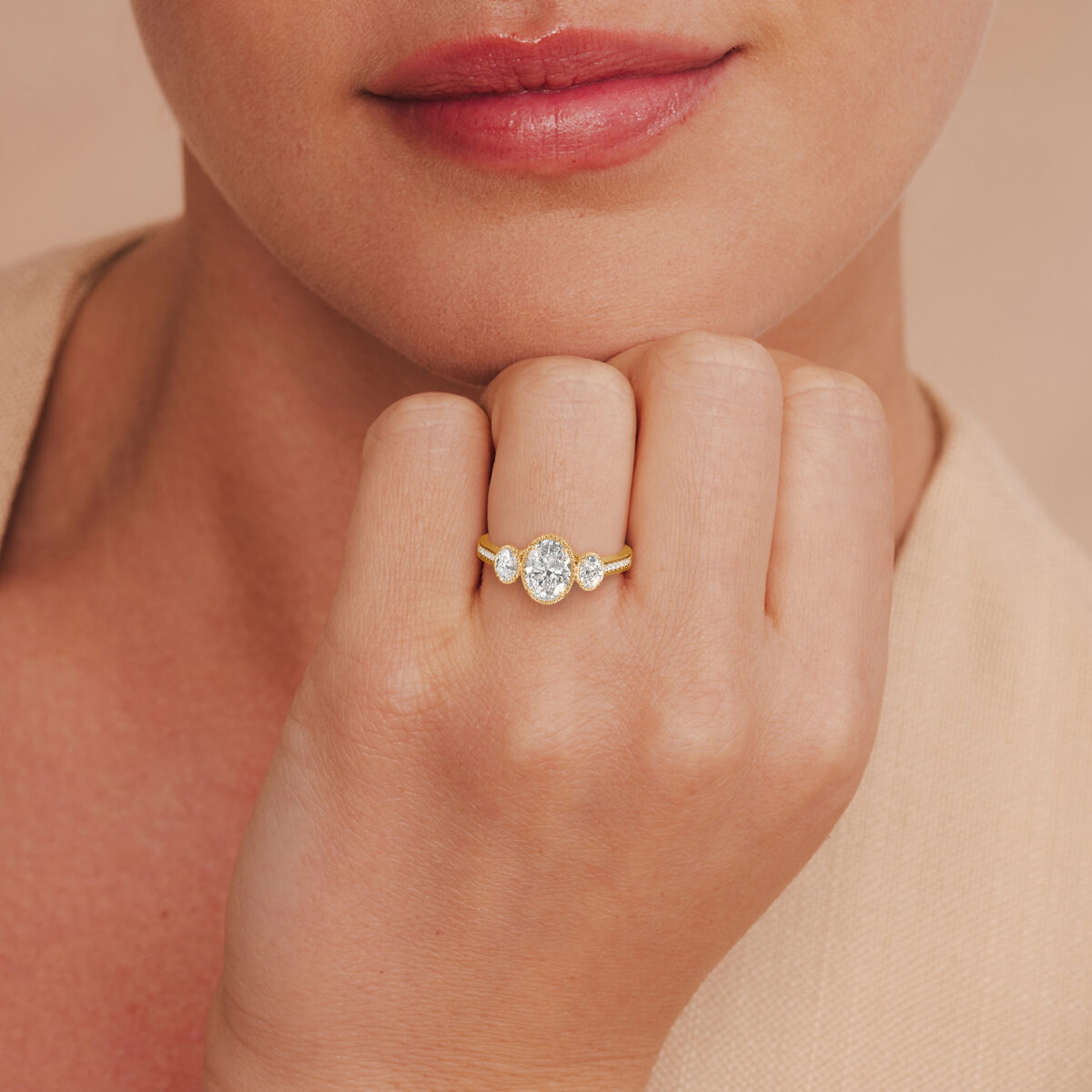
Thinking about popping the question soon?
Getting engaged is a milestone journey and, naturally, you want to nail the ring. To help you suss out the perfect sparkler, you’ll need to get familiar with the four Cs – the international standard for assessing a diamond’s quality and value.
Whether you’re keen on a classic look or eyeing up the latest celebrity engagement ring trends, knowing the ins and outs of the four Cs is key to buying smart.
- Carat weight
This refers to the diamond’s weight, not its size.
One carat equals 200 milligrams. Carat is often tied directly to perceived size and value, and so it’s likely to have the biggest impact on your budget. Don’t assume that bigger is always better!
You and your partner should decide if you prefer a single, larger stone (higher carat) or if you’d rather prioritise the quality of the other three C’s over the size. Here’s a tip: a slight drop in carat weight – say, from 1.00 to 0.90 – can result in a significant cost saving for a stone that looks the same to the naked eye.
- Cut
Arguably the most important C, as it refers to the diamond’s proportions, symmetry, and polish. A top-notch cut makes sure that the stone reflects light perfectly and creates sparkle. A poorly cut diamond, regardless of its colour or clarity, will appear dull and lifeless.
When you’re shopping around, always ask for the Cut Grade. This is ranked on a scale with Excellent being the best. If you’re buying a diamond engagement ring, most jewellers agree that you shouldn’t go any lower than Very Good.
Decide whether you’d prefer a traditional cut like Round Brilliant, which maximises sparkle, or a fancy cut like Emerald, Princess, or Oval, which emphasise unique shape and size. Some buyers believe that every cut has a different meaning, so this might matter to your spouse.
- Colour
Colour in a white diamond refers to the lack of colour, because the ‘perfect’ diamond is traditionally totally colourless.
Diamonds are graded on a scale from D (colourless) to Z (light yellow or brown). Bear in mind that D, E, and F are generally considered colourless, so you can expect to pay the most for these gems.
For a silver white gold or platinum setting, colourless or near-colourless grades (G, H, I, J) are the most desirable.
But if you prefer a yellow or rose gold setting, you can often opt for a slightly warmer grade (K, L) where the yellow tint is masked by the metal colour. This handy tip means you can allocate more budget to the cut or carat.
- Clarity
Clarity measures the number, size, and position of internal inclusions (imperfections) and external blemishes. The clarity scale ranges from Flawless (FL) down to Included (I).
Unless your partner is set on a Flawless stone, a smart compromise is to look for stones graded VS1, VS2, or SI1 (Very Slightly Included or Slightly Included).
Diamonds in these grades are generally eye-clean – meaning that their inclusions are invisible to the naked eye. This offers you excellent value without needing to sacrifice visual perfection.
Choosing a diamond doesn’t need to be a headache. By focusing on the Four Cs, you’ll gain the confidence to make smart trade-offs that suit your budget, all without compromising on quality or beauty.