
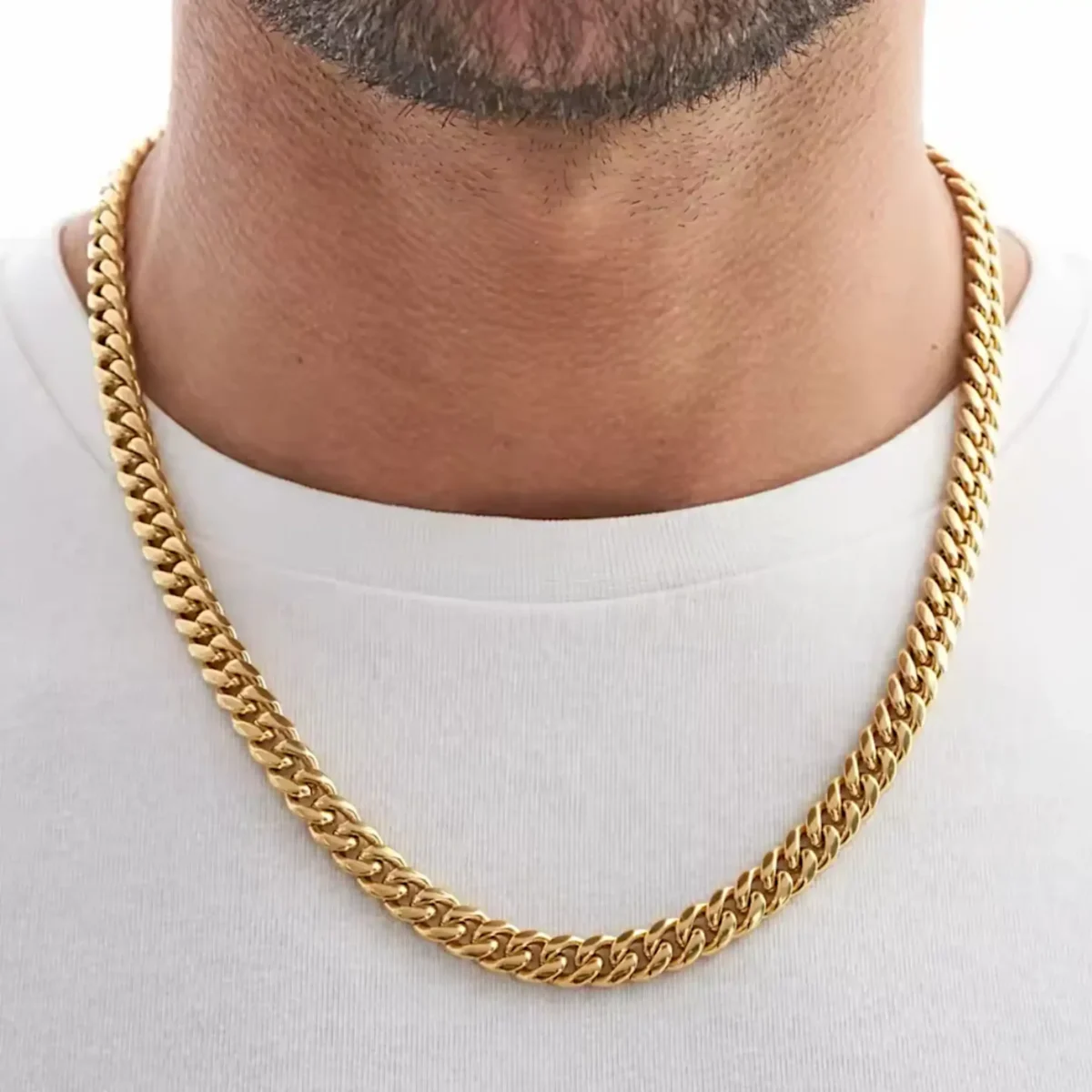
There’s a reason the first thing many people notice in a photo isn’t the shoes or even the watch—it’s the glint at the collarbone.
A thin line of silver at the base of the neck, a gold link resting just above the T-shirt seam, a heavier chain sitting over knitwear: in the last few years, men’s chains have quietly become one of the most important details in modern style. They’re no longer reserved for rappers, rock stars or footballers. They’ve gone mainstream—but not in a boring way.
Done badly, a chain can look like costume. Done well, it sharpens everything: posture, proportions, even how you carry yourself through a room.
This is a deeper look at how men are using chains now—what the different styles say, how length and thickness actually work, and why unique mens chain necklaces can do more for your wardrobe than another pair of trainers.
Why men’s chains are suddenly everywhere
They didn’t arrive out of nowhere. Three slow shifts pushed chains to the centre of men’s jewellery:
- Dress codes loosened, but didn’t disappear.
Once the tie began to vanish from offices and restaurants, men lost an obvious focal point around the collar. A chain stepped in. A slim line of metal against the throat or T-shirt fills that visual gap without breaking any unspoken rules. - Minimal wardrobes needed a focal point.
A rotation of well-cut T-shirts, shirts and jackets is efficient—but can look flat. A single mens chain necklace adds structure and depth with almost no effort. It gives an otherwise simple outfit something to “lock onto”. - Logos got louder than many men wanted.
For anyone tired of shouting brand names across their chest, chains have become a different kind of status: not about who made it, but about how it’s made—the link pattern, the proportion, the way it sits on the body.
The result? Chains are turning up on lawyers, designers, baristas, tech founders and finance guys alike. The difference between them is not whether they wear chains, but which chains they choose—and how.
The main families of men’s chains (and what they signal)
There are endless variants, but most men’s chains you’ll see fall into a few key families. Each carries its own attitude.
1. Curb chains: the quiet classic
The curb chain is the straight-talker of the group. Flat, interlocking links that lie neatly against the skin.
- Mood: timeless, understated, reliable.
- Best in: sterling silver, stainless steel, or white metals for everyday wear.
- Where it works: absolutely everywhere—from a hoodie to a blazer.
A slim curb chain at 50cm has become the default choice for men who want one chain that never feels out of place.
2. Cuban link chains: confident weight
A Cuban is essentially a curb that’s been hitting the gym. Rounded, tightly packed links with real presence.
- Mood: confident, bold, unapologetic.
- Best in: silver or gold, with enough thickness to justify the pattern.
- Where it works: nights out, streetwear, heavier outerwear, layered winter looks.
Worn right, Cuban link chains for men don’t have to scream. In the right metal and length, they sit in that sweet spot between statement and sophistication.
3. Figaro chains: rhythm & elegance
Figaro chains alternate between a few short links and one longer link, creating a subtle pattern along the collarbone.
- Mood: refined, European, slightly romantic.
- Best in: polished or lightly brushed silver, sometimes gold.
- Where it works: open-collar shirts, smart-casual tailoring, layered with pendants.
Figaros are perfect when you want more interest than a plain curb but less heft than a Cuban.
4. Rope chains: movement and shine
Rope chains twist the links into a spiral, catching the light from different angles as you move.
- Mood: expressive, textured, slightly vintage.
- Best in: mid-gauge silver or gold; too thin and they lose impact, too thick and they go full retro.
- Where it works: over T-shirts, under hoodies, paired with simple outfits that let the texture speak.
They’re particularly good solo: one rope chain, one watch, nothing else.
5. Box and snake chains: architecture in miniature
Box chains use square links; snake chains are tightly linked for a fluid, rounded look.
- Mood: modern, architectural, minimalist.
- Best in: high-quality silver or steel; finish matters here.
- Where it works: monochrome wardrobes, structured coats, sleek sneakers.
These are the chains that look like they were designed by an architect rather than found in a market stall.
Length, thickness, proportion: the rules no one tells you
A chain can be beautifully made and still look wrong if the length and thickness don’t suit you. A few guidelines:
Length
Most men end up between 45cm (18″) and 60cm (24″):
- 45cm (18″) – sits quite high on the neck; subtle under crewnecks. Best for smaller frames or very minimal style.
- 50cm (20″) – the “standard” length; rests around the collarbone. Works under or over most necklines.
- 55cm (22″) – slightly lower; great with T-shirts or open shirts where you want a visible drop.
- 60cm (24″+) – longer, more dramatic; usually worn over clothing, often with a pendant.
For a first chain, 50–55cm is almost always the safest bet.
Thickness
Think of thickness as volume on a stereo:
- 1–3mm – whisper: clean, discreet, perfect for layering or office wear.
- 4–6mm – conversational: noticeable but not shouting; ideal “one and done” width.
- 7mm+ – loud: this is where Cubans, heavy curbs and big textures live.
Your frame matters too. Broader chests can carry heavier chains more easily; slimmer builds often look best in medium widths with good proportion rather than sheer mass.
Metal and finish: what the chain is really saying
The same pattern can feel completely different in different metals and finishes.
Silver and steel: urban clarity
A silver or steel men’s chain is the default for many men for good reason.
- It plays well with navy, black, charcoal—most city wardrobes.
- It matches stainless watches and silver rings.
- It looks sharp in daylight and quietly luminous at night.
If your style is more London/Berlin than Miami, silver-tone metals are your natural home.
Gold: warmth and presence
Gold chains shift the temperature.
- Yellow gold leans classic and bold.
- Pale gold or brushed finishes feel more contemporary.
- Gold sings against browns, olives, creams and denim.
A slim gold chain disappearing under a shirt is one thing; a heavy gold Cuban over a T-shirt is another. Both can be right—the question is which world you live in more.
Black and oxidised finishes: quiet rebellion
Blackened steel, oxidised silver, and darker coatings lend chains a subtle edge.
- They feel less “jewellery shop”, more “art studio”.
- They pair beautifully with tattooed skin, black denim, leather, and chunky boots.
- They age interestingly: scratches and wear create contrast rather than ruin.
For men who don’t think of themselves as “jewellery guys”, a darker chain is often the gateway.
Chains with pendants vs chains on their own
When it comes to a Mens chain with pendant, both have a place.
On their own, chains are about line and texture. They’re like drawing a clean stroke across the upper body.
- Best for minimal outfits, strong faces, and men who like understated details.
- Box, curb and snake chains excel at this.
With pendants, chains become vehicles for symbol and story.
- Crosses, medallions, abstract symbols, initials, relic-inspired pieces.
- The chain’s job is to hold the pendant where it belongs: usually between mid-chest and sternum.
For most men, one pendant chain and one plain chain is a versatile pairing: sometimes worn together, often worn separately.
How to wear men’s chains without looking like you’re trying
The best chains feel inevitable—like they were always meant to be there.
A few rules that help:
- One focal point at a time.
If your chain is heavy or carries a bold pendant, keep everything else calmer: simple T-shirt, clean jacket, reduced logos. If your outfit is loud, let the chain be slimmer and quieter. - Coordinate with your other jewellery.
Silver chain + silver rings + steel watch = coherent.
Gold chain + gold-tone watch + warm accents = coherent.
Mixing metals is possible, but they should feel like part of a considered composition, not leftovers. - Learn your neckline.
Crewneck T-shirt? Chains look best either just below the collarbone or clearly below the neckline, not half-hidden.
Open-collar shirt? 50–55cm shines, especially with a figaro or box chain. - Respect context.
Most modern workplaces are fine with a slim chain. For ultra-formal events or conservative environments, tuck it under the shirt and keep it fine. Dinner, galleries, bars and off-duty days are when a bolder chain earns its keep.
Building a small, effective chain rotation
You don’t need a jewellery box full of metal. For most men, three pieces cover almost every scenario:
- The everyday chain
A 3–4mm curb or box chain in silver or steel at 50–55cm. It works with everything and disappears under a shirt when needed. - The statement chain
A heavier Cuban, rope or figaro at 5–8mm. This is your night-out, concert, gallery opening, or “I want to feel like the main character” piece. - The pendant chain
A slightly longer chain (55–60cm) designed to carry a meaningful pendant. Something that says something only you really understand.
Combining just these gives you multiple looks: plain everyday, stacked layers, pendant solo, statement chain over knitwear, and more.
Why chains feel different to other jewellery
Rings are intimate; bracelets are about movement; earrings change the frame of the face. Chains do something else: they redraw the architecture of the upper body.
They trace the collarbone, echo the line of the jaw, connect the vertical of the spine with the horizontal of the shoulders. That sounds poetic, but you’ve seen it: the guy in a simple tee and chain who somehow looks sharper than everyone else in the room.
Chains don’t create charisma. They frame it. They give it a line to travel along.
When chosen with care—right pattern, right length, right metal—a chain becomes less an accessory and more a quiet signature. You stop noticing it as a separate thing. It simply becomes part of the way you inhabit your clothes.